Disruptions on the railway
Around 3,800 trains run across the Netherlands every day. To make this happen, we rely on approximately 1,400 train drivers and 1,150 train conductors. Each of these trains and staff members follows their own schedule. We coordinate all of this to ensure the timetable is reliable.
You will particularly notice how challenging this is during a (major) disruption: the three schedules—tracks, personnel and trains—no longer align. For example, when a train is unable to continue due to an obstruction on the line.
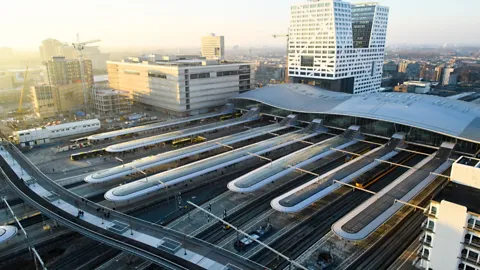
Timetable components
A timetable consists of three key components:
- Infrastructure: the railway network
- Personnel: train driver and train conductor
- Trains: the rolling stock
Together with ProRail, we coordinate these components daily, supported by advanced systems. If one of these components becomes temporarily unavailable, we cannot run according to the timetable. This is what we call a disruption.
Cause and effect
The causes of a disruption often come down to three factors: the weather, technology and human factors.
- Weather: heavy snow or a fallen tree can block a switch.
- Technology: a power failure can temporarily disable signals and systems.
- Human factors: a person on the tracks can block a section of the railway.
A faulty train can also block a section of the railway. The result? Delays for travellers.
The duration and impact of a disruption vary each time. Sometimes a minor cause has major consequences, while a complex disruption may hardly be noticeable. This depends on factors such as the time, location and previous disruptions that day.
Detection and analysis
Together with ProRail, we continuously monitor train services from a national control centre and five regional control centres. Signals from train staff or detection systems are received here. We then immediately analyse what is happening. What is the issue? How do we keep the railway and its surroundings safe? And what does this mean for the train service and for travellers?
Approach
Once we have identified the disruption, we work to get the trains running again.
This is a complex task, as we need to realign the timetable, personnel and rolling stock. Sometimes this involves difficult decisions: temporarily suspending services on a section can speed up recovery, even though we prefer to keep everything running with minimal delays. Our aim is always to keep the impact as small as possible and resume train services as quickly as we can.
Depending on the cause, we involve different parties. For a broken level crossing, the maintenance contractor takes action. In the event of a collision involving a person, the police, ambulance and fire services respond. The emergency teams from ProRail and NS also work together to assist travellers.
Logistical challenge
During a disruption, the timetable becomes unbalanced. Not all components are available in the right place. For example, a train may be ready but there is no driver available to operate it.
To run as many trains as possible, we use turnback points: stations where we can adjust the timetable for infrastructure, personnel and rolling stock. Trains travel to these points and then return, allowing us to avoid the blocked section. This may involve detours or alternative bus services.
The number of buses we can deploy depends on the duration, route and time of day. It is often more challenging during the Monday morning rush hour than in the middle of the day. During longer disruptions, NS staff are available at stations to provide information and assistance.
Travel information
During a disruption, we provide as much up-to-date travel information as possible:
- At the station via announcements and digital displays
- On the train through staff
- In the NS Journey Planner, NS app and website.
Sometimes this information takes a little longer to appear due to the complexity of the disruption or because systems are still processing data. Once we have clarity, we share the cause, expected duration and advice with travellers.
Restoring the timetable
Fortunately, there always comes a time when train services are restarted. Especially during major disruptions, such as a complete standstill of train traffic around Utrecht, this happens gradually. We begin with one train service (a fixed series of trains on a route). Once that runs on schedule, we start the next service. This way, we restore the full timetable step by step.
During this process, trains may temporarily run shorter or longer formations, or use different rolling stock. Trains may also be less clean, as the cleaning process can be disrupted by the disturbance.
Even after services resume, work continues: overnight, we ensure everything is ready for the next day, so the regular timetable can run again.